
"chemical reactions"
600 article(s) found

Explanation of the terms of fine coffee in coffee knowledge
Cupping: a way to test the quality of coffee, basically by placing ground fresh coffee beans in a cup, pouring them into hot water, soaking them, and then scooping them out with a small spoon without filtering. Extraction: precipitation of the desired substance by dissolving it through a liquid. Caffeine: chemical formula C8H10N402, the only nitrogen-containing plant base, refreshing, diuretic, relieving fatigue

Analysis of the aroma of coffee from a chemical point of view
Whether you are a coffee expert or an ordinary coffee lover, you will be attracted by the attractive aroma of that freshly ground coffee every morning. What you don't know is that this fragrance actually contains thousands of chemicals. To give you a better understanding of the chemical components of coffee aroma, we have drawn the following chart: in the face of such a complex chemical symbol, you may be

Coffee roasting: roasting process, roasting degree and roasting curve
When we pour the coffee beans at room temperature into the drum of the roaster after preheating, the temperature in the drum will be pulled down quickly and sharply, and the heat accumulated inside will be absorbed by the coffee beans and cause water evaporation. One minute to a few minutes later (the reheating time is related to preheating temperature, heating source, drum design, raw bean quantity, etc.), as the bean table loses moisture, coffee
Coffee knowledge points: coffee roasting talking about roasting process, roasting degree and roasting curve
When we pour the coffee beans at room temperature into the drum of the roaster after preheating, the temperature in the drum will be pulled down quickly and sharply, and the heat accumulated inside will be absorbed by the coffee beans and cause water evaporation. One minute to a few minutes later (the reheating time is related to preheating temperature, heating source, drum design, raw bean quantity, etc.), as the bean table loses moisture, coffee

What is the plum sodium reaction? Roasted coffee beans
Mena responded that recently more and more coffee shops have set up a roaster in front of the store to bake by themselves, so that they can not only save costs but also control their own quality. So walking on the street, you can often smell the unique aroma of roasted coffee beans, including the burning blue smoke smell of plant fibers, the sweet smell of cream, the brown smell of toast, and so on.

What is the main skill of making coffee by hand? do you need skill to make coffee by hand?
Professional coffee knowledge exchange more information about coffee beans Please follow the coffee workshop (Wechat official account cafe_style) to brew a good cup of coffee. In addition to the degree of grinding mentioned earlier, another important factor is the water temperature of hand-brewed coffee. In the process of hand flushing, water and coffee will undergo some complex chemical reactions, different stages produce different reactions, and the water temperature will be direct.

How much is the water temperature of hand coffee? the most suitable water temperature of hand coffee
Professional coffee knowledge exchange more information about coffee beans Please follow the coffee workshop (Wechat official account cafe_style) to brew a good cup of coffee. In addition to the degree of grinding mentioned earlier, another important factor is the water temperature of hand-brewed coffee. In the process of hand flushing, water and coffee will undergo some complex chemical reactions, different stages produce different reactions, and the water temperature will be direct.

Coffee roasting master the difference between roasting coffee and baking cake with fried chestnuts
Red wine juice coffee with nuclear coffee fruit, looks like cherry. Coffee beans, on the other hand, are the core of the fruit. According to the literature, early humans ate coffee fruits just like other fruits. As for drinking barbecued and ground nuts, it should be a later coincidence. At present, farmers in coffee-producing countries will keep dried dried fruits that have been dried and enucleated. Water drink, this drink called cascara is very sweet and tastes good

The chemical action produced by each cup of coffee Chemistry in every cup
English sentences are too professional and difficult to translate! Wait for English experts to translate and submit Coffee has a conflicting reputation is it a guilty pleasure or a life saving elixir? Emma Davies gulps down an espresso and investigates In Short Drinking coffee has been associated with a variet

What happens at each stage of roasting and the characteristics of coffee flavor with different degrees of roasting
Professional coffee knowledge exchange more information about coffee beans Please pay attention to what happens at different stages of roasting in the coffee workshop (Wechat official account cafe_style). Different roasting methods will affect the flavor, aroma and taste of the final coffee, because chemical changes occur at different time points during roasting. But no matter what kind of baking, baking is mainly divided into three stages: dehydration, Maynard.
Is the charred aroma of coffee exclusive to deep roasting? how do you describe the aroma of coffee? you can drink it.
Professional coffee knowledge exchange more coffee bean information please follow the coffee workshop (Wechat official account cafe_style) front street-coffee aroma sources introduce coffee beans in different roasting stages will change. After the raw coffee beans absorb heat, the color changes from green to yellow, and the moisture content of beans begins to decrease. Heat energy converts the water inside the coffee bean into steam and produces dioxygen inside the coffee bean.

Basic knowledge of roasting Coffee Bean roasting
The so-called coffee roasting (coffee roasting) refers to the process that through heating the raw beans, a series of physical and chemical reactions take place inside and outside of the coffee beans, and in this process, the sour, bitter, sweet and other flavors of the coffee are formed, forming mellowness and hue, and transforming the raw beans into dark brown beans. The original beans of coffee rely on professional technology to maximize the flavor of beans. Baked
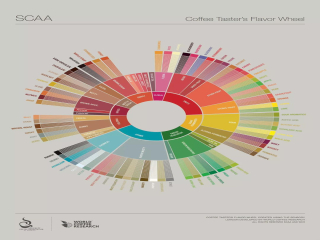
Talk about coffee flavor wheel basic knowledge of coffee culture 2023SCAA coffee flavor wheel high-definition map
Friends who love boutique coffee should be no stranger to this SCAA flavor wheel, but many say they don't understand it, so let's briefly talk about the structure and expression of flavor wheel today! The flavor wheel is divided into the negative taste spectrum on the left and the normal taste spectrum on the right. First, let's talk about the right half of the flavor spectrum.

What kind of coffee are roasted in medium depth?
What are the moderate dark roasted coffee? next, the temperature rises from 205 degrees to about 220 degrees, the color of the coffee changes from light brown to medium brown, and there is about 15% weightlessness. This chemical process is called high-temperature decomposition, in which the chemical composition of coffee beans changes and releases carbon dioxide. After the first burst, there was a pause in the burst sound, and then

What is the reason for over-extraction of hand-brewed coffee | tell you what is the principle of hand-brewed coffee extraction.
Professional coffee knowledge exchange more coffee bean information Please pay attention to the coffee workshop (Wechat official account cafe_style) the core principle of hand-brewed coffee is that it dissolves and spreads during roasting, chemical reactions take place inside the coffee cells, producing a variety of ingredients that emit coffee aroma and flavor. As a by-product of these chemical reactions, the slowly forming gas inside the coffee causes the cells to start

How do you get the aroma of coffee beans? How do we perceive the aroma of coffee? Those compounds produce aromas.
What produces the aroma of coffee? To understand chemistry we drink coffee in order to enjoy its unique flavor and rich aroma. When we pour or sip espresso, it is reminiscent of chocolate, caramel, almonds, fruits and flowers. But what happened at the chemical level? Each sensory characteristic is the result of chemical and biological reactions. Please read on to learn more about production
The origin of caramelization of the attractive aroma of coffee
Why do you love coffee so much? apart from the refreshing effects of caffeine, I think the reason why people and thousands of coffee fans often miss coffee is its charming aroma, so where does it come from? The important thing is that coffee beans are rich in a variety of raw materials, which produce a variety of reactions after baking, resulting in an attractive aroma. The two most important responses are
Coffee Flavor Chemistry the first academic monograph on coffee processing in China Coffee Book
The taste is delicious and fragrant. As can be seen from the advertising words of coffee, flavor is the soul of coffee. Recently, "Coffee Flavor Chemistry", co-written by Dr. Zeng Fankui of Lanzhou Institute of Chemical Physics of Chinese Academy of Sciences and Professor ou Shiyi of Food Department of Jinan University, was published by Jinan University Publishing House. This is the first academic monograph on coffee processing in China. Set
Professional coffee roasting | how to bake without temperature timing? Rely on the nose.
Communication of professional baristas Please pay attention to the coffee workshop (Wechat official account cafe_style) without a thermometer, I will only make a mess, but Willem Boot has set a few milestones for the bean baking process, which I think is quite valuable, although it is a bit brief. If you think the baked bean theory is too complicated, you can add or subtract it. The original text is here (but there is a big marking error in the article).